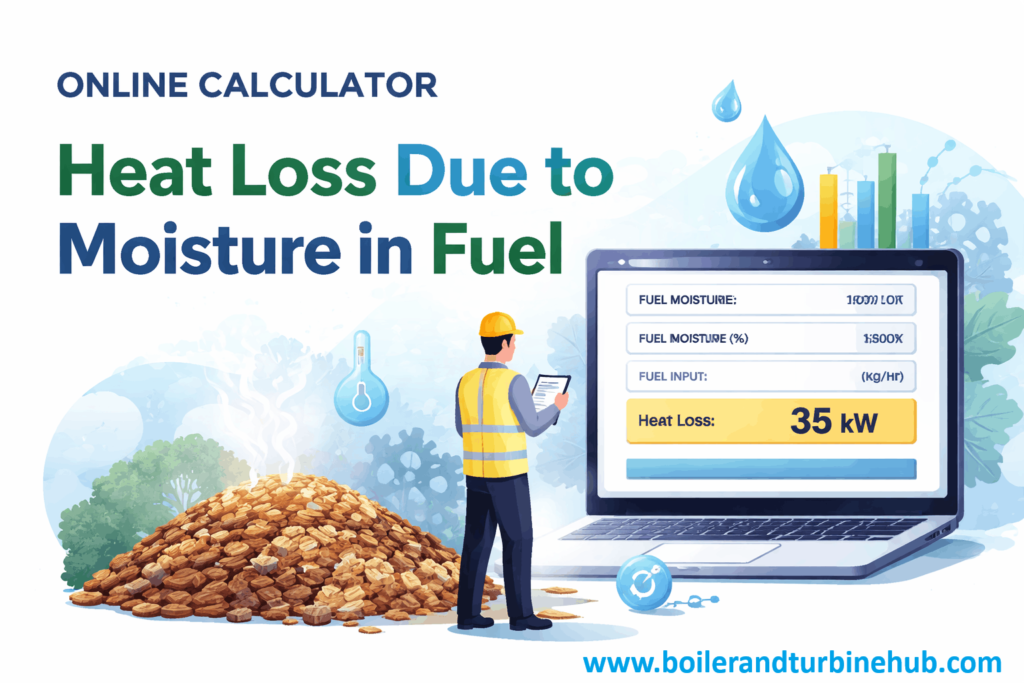

Moisture in fuel refers to the water content present in the fuel before combustion. It is typically categorized into:
- Inherent Moisture – Naturally present within the fuel structure (e.g., coal, biomass).
- Surface Moisture – External water due to rain, storage conditions, or handling.
When fuel containing moisture is burned, part of the heat released during combustion is consumed in:
- Evaporating the moisture (latent heat loss)
- Heating the evaporated steam to flue gas temperature (sensible heat loss)
This results in a direct reduction in useful heat available for steam generation or process heating.
What are the effects of moisture content in the fuel?
- High moisture content in the fuel leads to;
- More unburnt in ash
- Calls for more excess air
- More sensible heat loss: Water present in the fuel must be heated to its boiling temperature
- More latent heat loss. Water present in the fuel must be converted into steam. This requires significant energy:Approx. 540 kcal/kg of water at atmospheric pressure
- Heat loss due to dry flue gas will increase proportionally
- Steam pressure and temperature fluctuation
- Higher fuel consumption
- High moisture fuel have lower GCV
- High moisture fuel cause handling issues
- Fuel chutes jamming
- Travelling grate life reduces
- Plant axillaries power consumption increases drastically
- lagging and fouling (especially in biomass)
- Corrosion due to acidic condensation
- Increased emissions due to incomplete combustion
- Higher particulate matter
- Increased CO and unburnt hydrocarbons
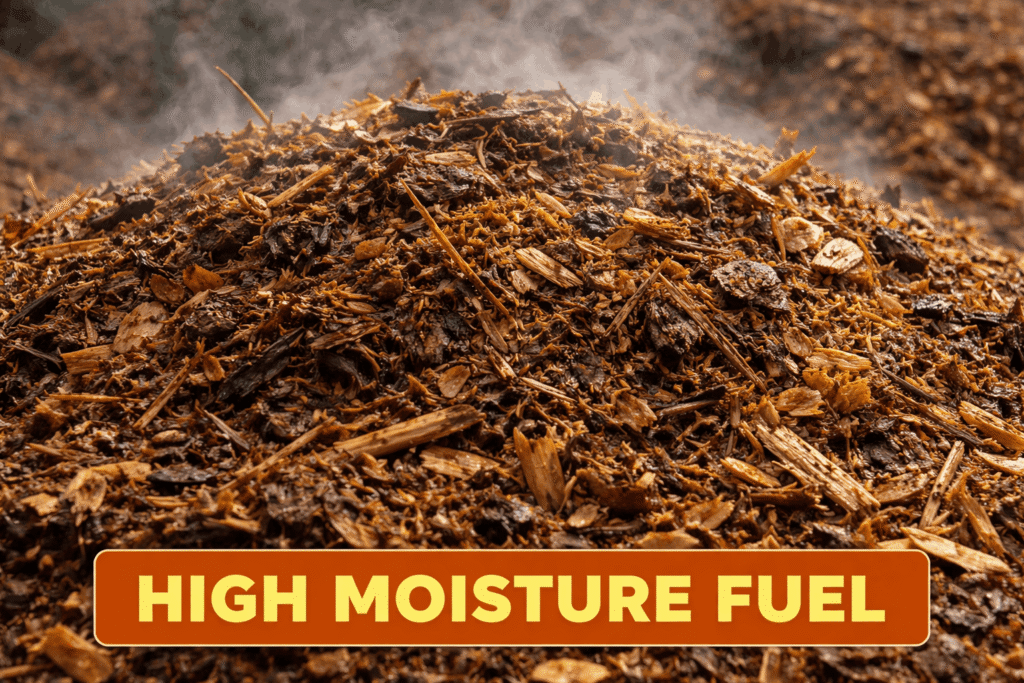
Moisture in fuel is not just a minor parameter—it is a major efficiency killer in combustion systems. It directly affects heat balance, increases losses, reduces flame temperature, and leads to higher operational costs.
For power plants and industrial boilers, controlling fuel moisture is one of the simplest yet most effective ways to improve efficiency, reduce emissions, and optimize performance. Proper fuel management, drying techniques, and operational control can significantly mitigate the adverse effects of moisture.
What precaution do you take for reducing losses due to high moisture content in the fuel
- Monitor fuel moisture regularly
- Procure recommended moisture content fuel
- Recycle the fuel to evaporate the moisture
- Install dryers for reducing moisture content from the fuel (Natural drying (sun drying for biomass),Mechanical dryers & Waste heat recovery dryers
- Mixing high moisture fuel with dry fuel
- Use of covered storage sheds for fuel storage
- Avoid rain exposure
- Use of silos or bunkers for temporary fuel storage.
Following formula is used to calculate the heat loss due to moisture content in the Fuel
Heat loss = M X (584 + Cp X (Tf-Ta)) / Fuel GCV in kcal/kg
Where,
M = Moisture in the fuel
Latent heat of vaporization of water is 584 kcal/kg
Tf = Boiler outlet flue gas temperature in Deg C
Ta = Ambient temperature in Deg C
Cp = Specific heat of steam 0.45 kcal/kg
Example:
A 100 TPH boiler consumes 10 TPH coal, having GCV 4700 kcal/kg, moisture content in the coal is 18%. Boiler exit flue gas temperature 145 Deg C, calculate the heat loss due to moisture content in the coal. Assume ambient temperature 28 Deg C
Heat loss = M X (584 + Cp X (Tf-Ta)) X 100 / Fuel GCV in kcal/kg
Heat loss = 0.18 X (584 + 0.45 X (145-28)) X 100 / 4700
Heat loss =2.45%